SGF Performance
Better Systems. Stronger Teams.
Smarter Businesses.
Every business faces challenges, from inefficient processes and disconnected systems to communication problems, stretched teams and limited visibility over performance.SGF Performance helps construction businesses, subcontractors and growing organisations identify what's holding them back and develop practical solutions that deliver lasting improvements.From bespoke Microsoft 365 applications, digital site records and automated workflows to leadership development, team performance and workplace wellbeing, we look at the bigger picture.Our approach brings together people, processes and technology to reduce inefficiencies, strengthen accountability, improve commercial visibility and help businesses work more effectively, profitably and sustainably.
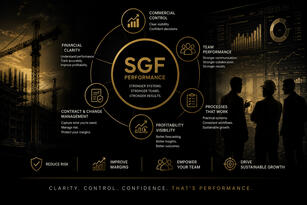
SGF Performance - How We Help
"Construction businesses rarely struggle because people are not working hard enough"
More often, pressure builds gradually behind the scenes. Commercial systems become reactive rather than proactive. Financial visibility becomes unclear. Forecasting confidence reduces. Communication gaps appear between teams. Processes evolve inconsistently as businesses grow, leaving leaders carrying risk without always having the information they need to make confident decisions.Over time, this impacts profitability, commercial control, team performance and business growth.SGF Performance was built to help construction businesses strengthen the commercial foundations that support sustainable growth.With extensive experience working within construction commercial management environments, from operational delivery through to commercial leadership responsibilities, we understand the pressures construction businesses face daily. Tight margins. Increasing commercial risk. Contract management challenges. Change management. Cost visibility. Forecasting accuracy. Growing teams operating under pressure.Having worked across commercial environments, we have repeatedly seen businesses lose profit not through lack of effort, but through missing structure, inconsistent commercial processes, limited visibility and communication breakdowns.SGF Performance helps construction businesses improve commercial control by creating practical systems and processes that provide greater visibility, stronger financial understanding and improved decision-making confidence.Our support includes:- Commercial systems and process development
- Project cost tracking structures
- Revenue and profitability visibility tools
- Forecasting and commercial reporting processes
- Risk and opportunity tracking systems
- Change management and variation management frameworks
- Contract management support and subcontract commercial controls
- Commercial team capability development
- Commercial knowledge sharing and team development
- Commercial performance and culture reviewsWe believe strong commercial performance is not built through firefighting problems after they happen.It comes from building clear systems, stronger communication, commercial visibility and confident teams who understand where projects are performing well — and where intervention is needed before profitability is impacted.SGF Performance exists to help construction businesses create that clarity.Not by becoming another member of your commercial team.By helping build stronger commercial foundations that support profitable growth.Requiring a more permanent solution?
Alongside SGF Performance, our sister business SGF Consulting provides independent Quantity Surveying and commercial support services for construction businesses and project teams. Where clients require support with commercial management, contracts, project controls, payments, or change management, SGF Consulting offers practical expertise to help projects remain commercially controlled.
Click the link below to visit the SGF Consulting website.
Contact
Let's start the conversation...
Whether you're looking to strengthen commercial processes, improve profitability visibility, develop stronger reporting systems or improve commercial team performance, SGF Performance is here to help.If something isn't working as effectively as it should, we'll help identify where opportunities exist and create practical solutions that support stronger commercial control and sustainable growth.Get in touch to discuss your business challenges.
Services & Fees
Commercial Systems & Profitability Review
Current commercial systems review and report.
- Cost tracking assessment
- Forecasting & profitability visibility review
- Contract & change management review
- Risk & opportunity tracking assessment
- Commercial reporting review
- Findings report & action plan
| Small Business | 1-10 Employees | £2,950 +VAT |
| Growing Contractor | 11-30 Employees | £4,950 +VAT |
| Established Contractor | 31-75 Employees | £7,950 +VAT |
| Larger Organisations | 75+ Employees | POA |
Commercial Process Implementation
Practical implementation of action plan from 'Commercial Systems & Profitability Review" to strengthen commercial control and embed improved systems.
This service is dependant on the outcome of the review and may include all or some of the below dependant on individual business requirements.- Cost tracking systems
- Forecasting tools
- Revenue & profitability reporting structures
- Risk & change trackers
- Contract administration systems
- Commercial templates
- Workflow improvements
| Essential Implementation | £3,950 +VAT |
| Growth Implementation | £6,950 +VAT |
| Full Commercial Performance Implementation | From £9,950 +VAT |
Commercial Team Performance & Culture Review
Identify leadership, communication and team dynamics impacting commercial performance.
- Leadership discovery session
- Anonymous team questionnaires
- Team resilience & pressure workshop - group sessions
- Commercial team 121 interviews
- Communication assessment
- Commercial pressure point analysis
- Findings & recommendations report
| Small Commercial Team | 1-4 Members | £4,950 +VAT |
| Medium Commercial Team | 5-12 Members | £7,950 +VAT |
| Large Commercial Team | 13-20 Members | £11,950 +VAT |
| Extended Team Performance | 20+ Members | From £15,950 +VAT |
Every construction business operates differently.Where required, SGF Performance provides bespoke support packages designed around business size, team structure and commercial complexity.Book a discovery call to discuss your business needs.
Commercial Systems & Profitability Review
What and How?
The Commercial Systems & Profitability Review has been designed to help construction businesses strengthen commercial control, improve visibility and create practical systems that support stronger financial understanding and more confident decision making.Our review identifies areas where commercial systems, reporting structures and processes can be strengthened to support sustainable business growth.
Stage 1 - Discovery & Commercial Overview
We begin by understanding your business.Initial leadership discussions are held with business owners, directors or senior commercial staff to gain an understanding of:
Current commercial processes
Existing reporting systems
Team responsibilities and structure
Commercial pressures and challenges
Areas currently causing frustration
Visibility over project profitability
Forecasting confidence
Contract management approaches
Current change management processes
Existing commercial controls
Stage 2 – Commercial Systems Review
We undertake a structured review of your existing commercial systems and workflows.
Areas reviewed may include:
Cost Tracking
Assessment of how project costs are currently captured, monitored and reported.
We review:
Labour cost visibility
Plant and material tracking
Subcontract cost management
Cost allocation methods
Commercial reporting consistency
Forecasting & Profitability Visibility
Understanding future project performance is critical.
We assess:
Forecasting processes
Revenue visibility
Profit forecasting confidence
CVR processes where applicable
Margin visibility
Commercial reporting quality
The objective is to improve confidence in project financial performance and reduce unexpected commercial risk.
Commercial Process Structure
We review whether existing processes support efficient commercial management.
Areas may include:
Internal commercial workflows
Commercial reporting structure
Change management process
Variation / compensation event processes
Commercial approval pathways
Procurement processes
Subcontract commercial controls
Risk & Opportunity Management
We assess how commercial risks and opportunities are identified, recorded and managed.
This may include:
Risk registers
Change tracking systems
Commercial exposure visibility
Revenue opportunities
Early warning indicators
Stage 3 – Findings & Improvement Opportunities
Once the review has been completed, findings are analysed to identify:
Commercial process gaps
Reporting inconsistencies
Visibility challenges
Forecasting weaknesses
Risk management opportunities
Contract administration improvements
Workflow inefficiencies
Areas impacting profitability
Stage 4 – Recommendations Report
You will receive a structured findings report outlining:
Key observations - Clear identification of areas requiring attention.
Priority improvements - Practical recommendations prioritised by business impact.
Commercial process opportunities - Suggested improvements to support greater control and visibility.
System recommendations - Where appropriate, recommendations for trackers, reporting structures or process improvements.
Implementation roadmap - Practical next steps to strengthen commercial performance.
Outcome
Greater commercial visibility
Improved forecasting confidence
Stronger commercial processes
Better profitability visibility
Improved reporting consistency
Greater commercial control
Clearer direction for future growth
Stronger Systems - Greater Visibility - Better Commercial Decisions.
Commercial Process Implementation
What and How?
Identifying commercial challenges is only part of creating stronger business performance.Long-term improvement comes from implementing practical systems, improving visibility and embedding processes that create greater commercial control and consistency across the business.The Commercial Process Implementation service has been designed to help construction businesses turn recommendations into practical action.Following a Commercial Systems & Profitability Review, SGF Performance works alongside leadership teams to strengthen commercial structures, improve reporting visibility and implement practical systems that support stronger decision making and long-term profitability.
Stage 1 - Implementation Planning
Before introducing improvements, we establish a clear implementation plan aligned with your business structure, operational requirements and commercial priorities.This includes:
Reviewing findings from the Commercial Systems & Profitability Review
Identifying implementation priorities
Agreeing key business objectives
Understanding team responsibilities
Defining success measures
Creating a phased implementation roadmap
This stage ensures changes are practical, achievable and aligned to how your business operates.
Stage 2 – Commercial Systems Development
Commercial systems are developed or strengthened to improve commercial visibility and reduce reactive working.Support may include:
Cost Tracking Systems
Development of practical systems to improve cost visibility across projects.
Examples may include:
Labour tracking structures
Plant cost tracking
Material cost visibility
Subcontractor cost monitoring
Project cost reporting tools
Forecasting & Profitability Visibility
Development of reporting systems that improve confidence in future project performance.
Support may include:
Forecasting frameworks
Revenue tracking structures
Margin visibility tools
Commercial forecasting improvements
Project profitability reporting
The objective is to strengthen visibility before commercial issues develop.
Risk & Change Management Structures
Commercial risks and change processes require clear visibility and consistent management.
Support may include:
Risk tracking structures
Change management processes
Compensation event management systems
Variation tracking systems
Commercial exposure visibility tools
Contract Administration Processes
Commercial processes surrounding contracts can significantly impact profitability and risk.
Support may include:
Subcontract commercial controls
Contract administration guidance
Commercial workflow improvements
Documentation structure recommendations
Approval process development
Stage 3 – Commercial Workflow Improvement
Commercial performance often improves when teams operate with greater clarity and structure.
This stage focuses on improving commercial workflow efficiency and reducing unnecessary pressure points.
Areas may include:
Internal reporting structure
Communication pathways
Responsibility ownership
Commercial handover processes
Team commercial accountability
Workflow bottlenecks
Process consistency
Stage 4 – Team Capability Development
Strong systems require confident teams.
Where required, SGF Performance provides practical support to improve commercial understanding and capability across teams.
Support may include:
Commercial process training
Commercial reporting guidance
Forecasting process understanding
Contract management awareness
Change management understanding
Commercial process knowledge sharing
Stage 5 – Review & Refinement
Following implementation, systems and processes are reviewed to ensure improvements are practical, effective and delivering value.Where required, adjustments are made to strengthen long-term performance.
Outcome
Greater commercial control
Stronger financial visibility
Improved forecasting confidence
Better project profitability visibility
Reduced commercial risk exposure
More consistent reporting
Improved commercial capability
Greater operational confidence
Practical systems designed to support sustainable growth
Practical systems. Greater visibility. Stronger commercial performance.
Commercial Team Performance & Culture Review
What and How?
Commercial performance is driven by more than systems and reporting.Leadership, communication, accountability, pressure, morale and team dynamics all influence how effectively commercial teams operate.As businesses grow and workloads increase, pressure can build quietly within teams. Communication gaps appear. Processes become reactive. Accountability becomes inconsistent. Team confidence reduces. Valuable people disengage.Commercial performance suffers.The Commercial Team Performance & Culture Review has been designed to help construction businesses identify the leadership, communication and cultural factors impacting commercial team effectiveness.Through structured review, confidential feedback and practical recommendations, SGF Performance helps businesses strengthen team performance, communication and commercial culture to support stronger business outcomes.
Stage 1 - Leadership Discovery & Team Overview
Every review begins with understanding leadership perspective.
Initial discussions are held with directors, business owners and senior commercial leadership to understand:
Current business challenges
Team structure and responsibilities
Areas of pressure
Communication concerns
Team performance challenges
Leadership frustrations
Retention concerns
Growth challenges
Commercial delivery concerns
This stage establishes understanding of current business pressures and leadership priorities.
Stage 2 – Team Insight & Commercial Team Assessment
Understanding how teams experience pressure is critical.
Team assessment may include:
Anonymous Team Feedback
Confidential questionnaires designed to understand:
Communication effectiveness
Team collaboration
Accountability
Workload pressure
Leadership support
Commercial process frustrations
Team morale
Confidence levels
Areas impacting effectiveness
This provides honest insight into themes that may not always be visible through leadership discussions alone.
Team Workshops & Observation
Facilitated sessions designed to improve engagement and encourage open discussion.
Activities may explore:
Communication challenges
Team pressure points
Commercial frustrations
Collaboration barriers
Accountability
Team effectiveness
Leadership visibility
These sessions also allow observation of team behaviours, communication patterns and interaction dynamics.
Resilience & Pressure Discussions
Where appropriate, structured discussions around workplace pressure, resilience and communication may be incorporated to support stronger awareness and team understanding.The objective is not therapy.The objective is creating stronger communication and healthier team functioning within high-pressure commercial environments.
Stage 3 – Confidential Team Interviews
Individual conversations provide greater understanding of team experience.
Areas explored may include:
Communication & Collaboration
Communication effectiveness
Team interaction
Information sharing
Cross-functional relationships
Leadership
Leadership visibility
Support structures
Clarity of expectations
Accountability
Decision making
Commercial Pressure & Working Environment
Workload pressure
Reactive working
Process frustrations
Burnout indicators
Team support
Workplace confidence
Team Dynamics & Retention Risk
Team morale
Trust
Engagement
Areas creating frustration
Potential retention concerns
This stage often identifies themes that impact performance but remain hidden within day-to-day delivery.
Stage 4 – Analysis & Findings
Findings are reviewed to identify:
Communication breakdowns
Leadership challenges
Pressure points
Team dynamic concerns
Process frustrations
Commercial delivery barriers
Accountability gaps
Retention risks
Areas impacting team effectiveness
Patterns are assessed alongside leadership insight to build a clear picture of current team performance.
Stage 5 – Findings Report & Recommendations
A structured report is produced outlining:Key Findings- Clear summary of observations and themes.
- Leadership Observations
- Areas of strength and opportunity.
- Team Performance Findings
- Communication, accountability and collaboration insights.
- Commercial Team Pressure Analysis
- Factors influencing workload pressure and effectiveness.Recommendations- Practical actions designed to strengthen communication, team effectiveness and commercial culture.
- Implementation Roadmap
- Clear next steps to support long-term improvement.
Outcome
Greater understanding of team dynamics
Improved communication visibility
Stronger leadership insight
Increased commercial team effectiveness
Greater awareness of pressure points
Improved team confidence
Stronger retention foundations
Greater alignment between leadership and team experience
Practical recommendations designed to strengthen long-term performance
Stronger communication. Greater accountability. Higher performing commercial teams.